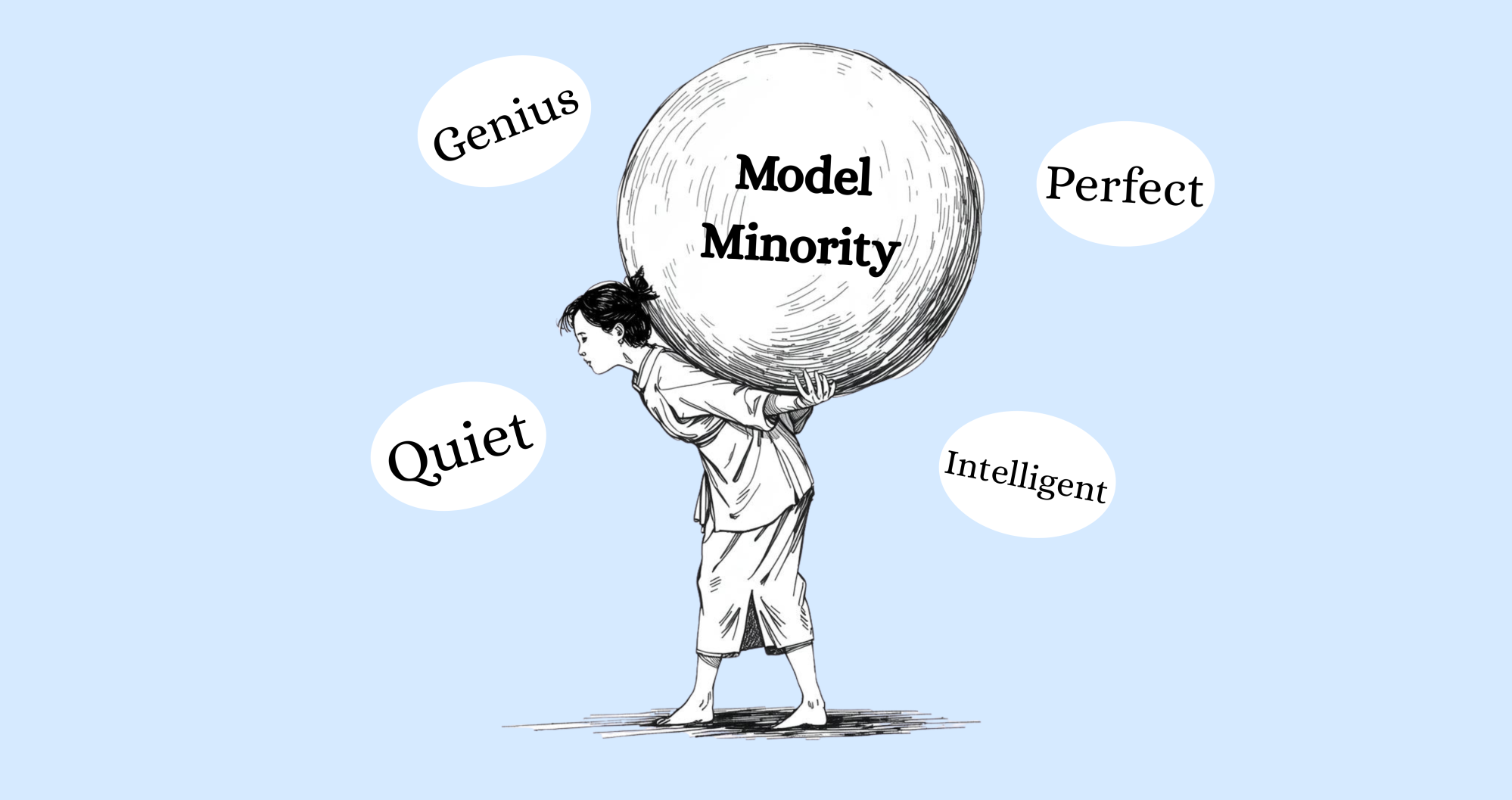

The model minority myth is known throughout many areas across the world. This racialized social construct is used to frame specific minority groups, particularly Asian Americans, with seemingly similar traits. This places an unfair situation on minorities who live with the expectation of being how society sees them. It explains how Asian Americans are seen to be more intelligent, financially successful, and compliant. They are stereotypically considered to be musical prodigies, math geniuses, and bad drivers. But these stereotypes continue to grow not only within these groups, but are also seen in many minority groups throughout society.
This issue can be traced back to years of racism and systems of oppression that many countries were based off of, where white supremacy is apparent and their beliefs are strongly represented. However, these ideologies are generalized and do not represent the Asian American experience. The truth is that Asian Americans are not a homogeneous group. There are dozens of ethnicities, languages, religions, immigration histories, and social classes within Asian Americans, including those who are refugees fleeing war and those who have lived in this country for generations. They have different cultural, socioeconomic, and historical experiences. The model minority myth obliterates these differences by reducing individuals to one experience of success and compliance, disregarding the struggles that many individuals face, such as poverty, language issues, mental illness, and discrimination. For example, Southeast Asian American communities have high rates of poverty and low educational attainment, which are not typically discussed within the mainstream discourse of the myth.
According to Pew Hispanic Center, 63 percent of Asian adults report experiences where people assume they are good at math and science or not creative, reflecting how widespread these stereotype-driven assumptions are in everyday interactions.
Although the stereotype seems “positive” at first glance, it is actually very damaging. Unlike negative stereotypes, the model minority stereotype is very subtle, hiding discrimination behind compliments and admiration. By depicting Asian Americans as universally successful, the stereotype is often used to discredit their experiences with racism and the need for support or policy change. When Asian Americans face racial violence, employment discrimination, or educational obstacles, their experiences are often downplayed because they are expected to be resistant to adversity. It also fosters a tremendous amount of pressure on the individual to live up to unrealistic standards, which can cause anxiety, burnout, and feelings of inadequacy when these standards are not met. Students who are not academically successful may feel like failures because they are personally inadequate instead of being limited by an unfair system.
Moreover, the model minority myth is also a means of maintaining systemic racism by creating a rift between marginalized communities. It is often used to imply that other minority groups are to blame for their own oppression, perpetuating the misconception that achievement is solely the product of hard work and not the availability of resources and opportunities. This is because it disregards the effects of racism that differ from one community to another. The myth is also useful to systems of white supremacy in that it portrays Asian Americans as submissive and non-confrontational. This serves to discourage political activism and resistance. When Asian Americans do speak out against injustice, they are perceived as being different from the stereotype and are therefore silenced. The stereotype of the submissive Asian American serves to further limit representation. The model minority myth also ignores the fact that Asian Americans still continue to face racism and racial violence. For instance, the increase in anti-Asian hate crimes, especially during the pandemic, showed the vulnerability of the stereotype and the ease with which “model minorities” could be labeled as outsiders. This shows that the model minority myth does not protect Asian Americans from racism; instead, it makes the rest of society ignore the issue until it is impossible to deny.
“The model minority myth obscures the real challenges facing Asian American communities and pits minorities against one another,” Frank H. Wu, legal scholar and former president of Queens College said.
Ultimately, to overcome the model minority myth, it is important to understand that it was created through racism and that there is a need to recognize the humanity of Asian Americans beyond stereotypes. This involves understanding that it was created to further a political agenda, to perpetuate inequality, and to affect not only Asian Americans but other minority groups as well. By understanding the diversity of experiences, it is possible to start to overcome stereotypes and work toward a more honest understanding of race and identity.