Sight, smell, hearing, taste, and touch. Our five senses are crucial when going about everyday life. In school specifically, we are able to see visuals our teachers provide us with, hear and take in new information, smell and taste a hearty lunch in the cafeteria, and use our touch to complete hands-on activities. While the relentless demand of school can begin to seem overwhelming, consider how fortunate you are if you are able to learn visually, aurally, and linguistically, with no cost or impairment.
Some students don’t have the same opportunities and need extra assistance when it comes to comprehension. Those with blindness, hearing impairments, or other disabilities don’t have as easy of a routine as the vast majority. There are school employees that provide non-instructional help to students, which can include paraprofessionals, behavior support staff or teaching assistants. Tracy Fitch, a teacher for the blind and visually impaired, works to ensure that all students are able to get what they need out of school.
Q&A with Tracy Fitch
Q: How did you embark on getting your masters in being a teacher for the Blind and Visually Impaired?
A: It’s an interesting, complex story. My bachelor’s degree was not in education. After I graduated from college, I didn’t know what I wanted to do. I was looking for jobs and began substitute teaching when one day I got called in one day for a week-long sub job with a student who had just moved to Georgia. She was a completely blind, first grade braille learner. The week-long sub job ended up turning into a paraprofessional job. I fell in love with the field. My amazing mentor encouraged me to pursue this field. That was when I started my master’s degree and began teaching provisionally until I finished my master’s and became fully certified.
Q: So you didn’t know any braille prior to this?
A: No. When I was your age, I didn’t even think about kids with special needs. It didn’t dawn on me how they were served or what that population looked like. I had never encountered a person who was blind or visually impaired before, so this job wasn’t something that crossed my mind.
We are considered low incidence, which means when you look at the population of kids who are special needs, blindness – along with DHH (deaf hard of hearing) is very rare. There are less students we serve with those disabilities, so there are less teachers of the blind and teachers of the deaf.
Q: What does a day in your life look like at MHS?
A: I’m itinerant. The majority of our kids are at the high school this year, but I have had kids, and do have kids, at other schools. A couple years ago I might’ve started at an elementary school, and then gone to the sixth grade academy, and then went back to an elementary school. Two years ago, half my day was at the middle school and half my day was at the early learning center. This year I’m primarily at the high school, but I do lots of assessments and meetings at other schools. Normally, if I’m just at the high school, I have students that I serve with IEP’s (Individualized Education Program) goals, and other things I have to work on with them. The rest of my time is spent either going into the classroom with kids, or making sure they have the materials they need in the correct format.
Q: Do you think there are any misconceptions about what you do?
A: I think there are a lot of misconceptions about blindness and what people who are blind are capable of. Some people choose to be ignorant, but a lot of people can’t help it because they just don’t know better yet. We try to be as gracious and patient with people as we can and educate them along the way.
Q: What makes Marietta special or different from other school districts you’ve worked in?
A: I like that it’s small. It makes it easier to travel. In Cobb County, I’d have to go from East Cobb to West Cobb, which can be quite a commute. But with Marietta City, there’s just a few minutes between each school. I also like that it feels like a family. I feel like my supervisors legitimately have my back and really do support me. I feel heard.
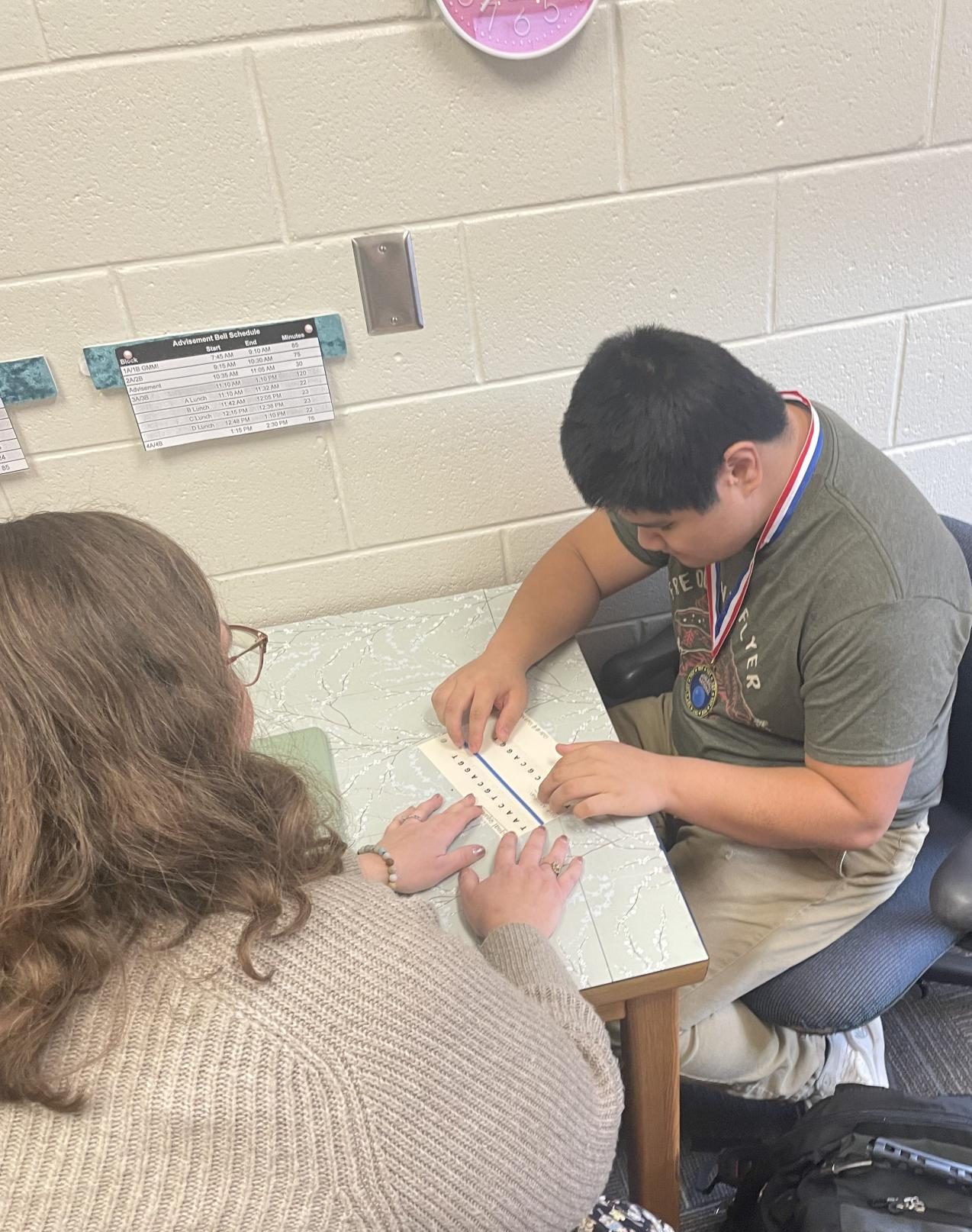
Ms. Fitch explained that there is no device that can translate pictures into braille. She is the one who has to translate and create images in order to serve braille learners at our school. George Eaker, a ninth grade student, has to use braille and other devices, in order to get what he needs out of school. Ms. Fitch is crucial to his learning. George’s circumstances do not stop him from experiencing MHS to its fullest potential. He is an amazing percussionist in our school’s band, an excellent writer, and an overall phenomenal student.
Q&A with George Eaker
Q: How has the way you do work changed from elementary school to middle school, and from middle school to high school?
A: From what I can remember of elementary school, my work was very easy during kindergarten and first grade. I didn’t need that much in terms of work since I was busy learning braille at the time. For most of elementary school, I got work on paper until I got a Braille Note Touch Plus, which, after learning how to use it efficiently, allowed me to get some of my work digitally. The way I do work has not changed much from middle school to high school.
Q: How has Ms. Fitch made school more accessible for you? What challenges have you overcome with her help?
A: She provides tactile graphics for classes where students are looking at visual graphics. She also always makes sure I have access to assignments, either digitally or physically on paper. With Ms. Fitch’s help, my work has become more accessible.
Q: What is your favorite subject and why? What subject is the hardest for you and why?
A: My favorite subject is band because I like playing music. I am a percussionist, so I get to play a wide range of instruments. I don’t know how to read music like my friend who is also in band at another school, so I have to learn by ear, but I’d like to think I’m still good at playing music. The hardest subject for me is literature. I regularly have to write creatively, and though many people say I am a very talented writer, I struggle with coming up with ideas and putting them into words in a way that I like.
Q: What is something you wish people knew about you?
A: I love trying new things.
Accessibility is pivotal in a school environment, but often goes unnoticed. Making sure that everyone is afforded the same opportunities to learn, grow, and advance is something that should always be acknowledged. Additionally, so many teachers and staff members don’t get their flowers for the important work they do. Being more cognizant when it comes to the people around us, is the first step to a more empathetic school.