








































Was anyone else sweating under their holiday sweater this Christmas? Well you’re not alone. In fact the National Weather Service reported that the temperature on Christmas Eve was at a record high this year for the metro Atlanta area. And Atlanta isn’t alone in this, record high temps were also reported in Tennessee and New Mexico.
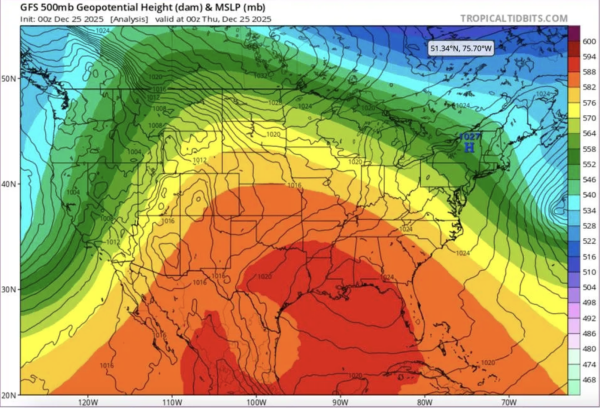 The cause of this heat can be attributed to a “Heat Dome” which is the large pocket of high air pressure you see above the United States According to NOAA a heat dome is defined as “an exceptionally hot air mass that develops when high pressure aloft prevents warm air below from rising, thus trapping the warm air as if it were in a dome.”
You’re probably thinking that this is all because of global warming, and you’re on the right track. But it would be reckless to baselessly assume that one hot Christmas is evidence of global warming. But it would be just as reckless to completely ignore it when regular winter weather returns the next week. The truth is that one hot holiday doesn’t support or refute global warming. However, there is evidence that the climate is warming.
“Every heatwave in the world is now made stronger and more likely to happen because of human-caused climate change,” according to Ben Clarke from the University of Oxford.
The CSI (Climate Shift Index) was invented by the organization Climate Central to measure the effect of human caused climate change on the environment. During the holidays CSI levels of three have been forecasted for across the nation, and the CSI has reached a level of five (The Highest Possible) in some areas of Missouri and New Mexico. With this information we can reasonably conclude that the holiday heat we experienced was a result to climate warming.
Reversing and preventing global warming is no small task, and it’s going to take all of us working together. Ways you can individually reduce your climate footprint include: powering homes with renewable energy (solar), avoiding single use plastics, carpooling, walking, or biking, instead of driving, supporting positive policy change from the government, and much more. For more information on how to stop global warming visit www.Climate.gov.